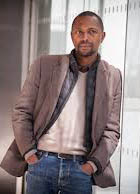

Togara Muzanenhamo Poems
At first the stubborn growth resists him, till each stroke
is fluently flung to clear the knee-high grass, his task
down to an art, the pendulous swing of knees slightly
giving, his right arm catching the sun wet off the blade.
All day the work, shuffling steps into shuffled clearings,
beetles and crickets rising off cordite clicks sparking
off stone, bearded chin sequinned with sweat. The heat
seems not to bother him, but steels his concentration
deep in the trials of his faith. Why the sun rises and falls,
why his jaundiced wife believes God will save them all,
is just as unclear as why his newborn's unfinished death
hangs heavy on every dawn. In the music of his labour,
each composed thresh throws slashed grass to sunlight,
each mastered stroke floats timed beneath the weight
of the sun burning deep into his heart, the mastered art
of his arm fluent with the song the hours constantly sing.
...
He will not understand her fascination
with rain, these summer months of water
that somehow keep the money coming in,
paying for the nurses his granddaughter
has slowly learnt to trust. Now all the good
help is gone, he feels he can spot liars
with one look; and if he could, he would
take care of her himself. All these prayers
for a new body! She doesn't understand
the joke, but simply stares out the window
where an old broken-down tractor stands
in the backyard, grass screaming out of
worn sprockets, joints rusting above slow
gulfs of shadow shot wild with foxglove.
...
James A. Mattern, noted flier, was granted permission by the Commerce Department today to make an aerial search for the Russian aviators believed lost in the Arctic wilderness.
In making the search, Mr. Mattern will be returning a favor from Sigismund Levanevsky, leader of the Russian flight.
The Russian went to Mr. Mattern's rescue a few years ago when the American aviator was marooned in Northern Siberia.
Pittsburg Post-Gazette, August 15, 1937
From Weeks Field the sun hangs uncertain,
the air sharpened by the curse of razored winds -
sheets of sky and sea layered silver with ice.
Each hour vanishes into broken distances,
the shape of the world formed on each breath, oiled drops
shivering wet off rivets - the engine
moaning dark at the wrists.
Evening swivels west as the Texan turns,
her wings banked shallow above the ocean's crust -
pedals and levers at their place for altitude.
Through angled glass, the quiet world of a frozen
solitude, a vast naked bridge of bruised light bridging continents,
white skirts of blind speed beaming
over lengths of desolate prose.
The radio crackles white with endless noise,
the ceiling of the world dry with fate.
And banking into the failing light, he remembers the furled
wisps sparked by whips of air turning up as the Russian landed -
then, the rattled chop of blades as the plane left for Nome,
the compass marked for home and all
the vaporous qualities of life.
Time sinks fast, darkening with ancient layers
creaking below, unsaid prayers the dead
have set to verse. A grey breath of air slips heavily
off each wing, the flat drone of the engine working
the mind to paint the final flight with a grieved art - the soul's white feathers
burning bright as the prototype rolled and crashed
deep into the heart of the unknown.
...
Last week saw the last of the summer's heat. Tonight, the first cool drafts bring the smells of cooked dinners into the room. The faint sounds of dishes in sinks seep through the walls as children play ball games beneath streetlamps speckled with insects' wings, and the final nuances of the summer sky take time to fade.
And two screams in shadows and shade - one of laughter, one of fear; a boy with a look of grown-up avarice chases another to the bright safety of a front door. The pursuer stops not far off the threshold - winking, pounding his fist on the gate, for he knows there'll always be a tomorrow.
And tomorrow's autumn by date, handfuls of leaves have fallen, yet the air is still summer's apart from the fostering a colder tinge when the sun sets. Ball games will stop with the oncoming pace of winter's darkness, smells of cooked dinners will be retained in safe, heated, houses; and by the gate, still pounding his fist, the runner's pursuer will wait for that tomorrow which never fails to come.
...
They still drew the old roller over the cricket pitches with men
yoked like a team of oxen to the stubborn iron wheel.
The grass smelt as the grass did, all rich beneath the afternoon sun -
the heat flashing to the ground with a blinding flick of steel.
All the fields were there - but much smaller than remembered -
the rugby and football grounds unused, the whitewashed lines
washed out by the rains, but the names of dead Jesuits, on signs,
still stood on the preened edges - in traditional white and red.
Up into view the memorable tower of stone rose with all the dreams
of climbing up the winding cool stairwell, up to the top of the turret
where thoughts of fields, soft with breaths of Natal grass, met
the sky with hope and refuge. But those were just a schoolboy's dreams
brought on by the sight of the huge bronze plaque of St. George
plunging his spear, extinguishing our fears of the dragon.
Though all that bullshit vanished with age, the staged hero on the forged
plaque still remained some old myth the Jesuits liked to work on.
'I'm here to go through the Chronicles.' ''86 to the mid 90's.'
The receptionist is grey and half-deaf, I'm apparently soft spoken -
so there's a lot of repetition accompanied by grimaces and apologies.
'I'm here to go through the Chronicles.' 'Yes', to another question,
'I did attend here some years back.' 'Yes, an Old Georgian, an old boy.'
The phone slowly goes up to her ear as she mentions something
about visits and strange requests from foreign journalists wanting
to sit in on classes or have private interviews with the boys.
'Penny?' 'Yes, Penny it's me'. 'I seem to have a safe one here.'
'Wants to go through the Chronicles.' 'Something about poetry.'
Her small eyes look up. 'You do remember the way to the library?'
I had forgotten, but then retrace the steps in my mind to get there.
Each class I pass, a voice spills from the mock-Edwardian windows,
the red polished floors tap under my feet, and a sweet blessedness
fills me that I'm not sat in those sweat-rooms of learning, shadows
of my youth, daydreaming about a new-world after the first kiss.
The study-hall has lost all its desks and holds an array of instruments
and chairs for classical musicians. The fountain in the quad is gone now,
and at first it didn't mean a thing to me - but then a crude bewilderment
took hold when a memory tried to find its place in the absence; and how
on earth they removed it had me lost - the lawn was perfectly smooth.
The weights' room, where our hands were beaten blue by a leather wad,
where iron was pumped on hot afternoons, was now clean and had
the smell of sweat and leather replaced by veneered internet booths.
Outside an office a boy lifted his hat and said 'Good morning' in a way
that had me question what he'd said. It was only when I looked back
that I noticed the strain on his face, his rheumy eyes and the big black
words scoured across his chest, FAGGOT. I could see how easily they
could have pinned him down. The tree was there where we sat at break
trying to forget the colour bar that still hasn't faded outside the gates;
the smell of musasa leaves and old orange peels revived a dead ache
that filled my belly: a mob outside the science-labs, fists of other kids...
When I met Penny she smiled, and something told me
it wasn't a strange request to come here and go through the Chronicles.
She had them stacked up on her desk, all piled up chronologically -
towers of memories, names and dates in black and white at my disposal.
I sat down, leafed through the pages, the photographs alive in my head;
and after an hour of being immersed in the vivid quiet, the bell rang:
It was still that same high-pitched drill that once brought relief as it sang
through the long corridors, but with it also came a certain dread.
...
Across the service road, block-faced tractors carve fields
into narrow ridged lanes. Dust trails rise from the furrows,
curling above paddocks licked gold with windswept grass.
The vet takes off his shirt, browns his arms to the elbows;
standing back - he studies the cow's prolapsed womb,
palms level with his chest in some sort of medical prayer.
After a moment's thought, the sun beating hard on his back,
he leans in to cradle the womb with a mastered stoicism.
Gently he purges the muscle of grass and earth, rust-red water
flowing down her hocks, her head locked in the steel spasm
of the crush, eyes lost in the rolling shine of paddocks.
Pale signatures of dust scrawl the sky, the whispered strokes
vanishing into a blue canvas. In the pen, her day-old calf
springs about on giddy legs, the black calf shiny as split coal.
A whirlwind rises, stirring up dust and flamboyant petals.
Again, the gentle bath; but first a warm slap, a fresh bowl
and murmurs of song; his battered box open, needles, blades
and bottles spinning hypnotic webs of light over his elbow.
He shaves the base of the cow's tail. Slides the needle in.
He lifts the bright muscle, but pain dismantles her stance,
so he waits - blowflies glittering in the heat like emeralds,
her braced dance, swaying, gradually returning her balance.
Then, with an assured commitment, he guides the uterus in.
Everything beneath the sun gives stage to loud sequential farting,
a sherry rush of liquid courses down the vet's arm, into his
armpit, down his flank, to his work-trousers - the pale fluid
forming faint maps. Purposeful and red, a steady rain of petals
falls. The polished hum of bees bright beside the grading shed.
And as delicate as light salted by the sun, wafts of medicine
and dust ride the air with a perfume the whole scene needs.
...
Both men spat red dirt, the tractors' engines echoing off cypress
windbreaks smudged silver with heat - gears, shafts and star-wheels
circling raw motion into windrows. Dust steamed off mown grass,
fields stripped back with lizards and mice darting beneath kestrels
locked to the sky. Distant thunder drummed its black murderous
roll - diesel plumes floating thick above the spot where the drivers
stopped, disembarked and went for each other beneath the ulcerous
sky. Next morning a constable was called. At the stables mourners
stared into red earth - the blue sky drilled clean with a white sun.
Out in the field, a tractor and baler ran jettisoning bales lashed taut
with twine, the tractor simply swerving over ground where the iron
bar had been found, ruby wet with dew, where the men had fought.
...
The late hour trickles into morning. The cattle low profusely by the anthill
where brother and I climb and call Land's End. We are watchmen
overlooking a sea of hazel-acacia-green, over torrents of dust whipping about
in whirlwinds and dirt tracks that reach us as firths.
We man our lighthouse - cattle as ships. We throw warning lights whenever
they come too close to our jagged shore. The anthill, the orris-earth
lighthouse, from where we hurl stones like light in every direction.
Tafara stands on its summit speaking in sea-talk, Aye-aye me lad - a ship's a-
coming! And hurls a rock at the cow sailing in. Her beefy hulk jolts and turns.
Aye, Captain, another ship saved! I cry and furl my fingers into an air-long
telescope - searching for more vessels in the day-night.
Now they low on the anthill, stranded in the dark. Their sonorous cries haunt
through the night. Aye, methinks, me miss my brother, Captain of the
lighthouse, set sail from land's end into the deepest seventh sea.
...
She held papers to the conceptual republic and stood at the check-in desk with no luggage, just her papers and her ticket. She was leaving soon. A sense of family surrounded her.
Antwerp. Midwinter. I stood in a bookstore reading the large black words in children's picture-books. For days I had been standing there, going through the shelves, not really knowing what I was looking for. And although I knew all the characters in the books were dead some of the images kept moving.
The departure lounge was full. Everyone had a seat on the flight. No one spoke. Yet she heard indiscernible voices seeping through the air as though spoken from behind a screen of warm wet cardboard. As they waited, she stared ahead, and there everyone had a something, they saw.
I remember I had written the book I was reading. The words on the final page were mine - as I read them I realised I knew them by heart. A member of staff asked me if I needed help. I began to cry shamelessly and replied as I had replied before.
The plane prepared to take off into the night sky. She grew tired thinking of the journey. She was directed to her seat, and sat next to a polite old man who smelt of apples and tobacco with hints of cinnamon and seaweed. As the inertia of the roaring vessel hijacked her body, she fell asleep.
There were no names on the books. I felt a strong childhood longing to hear my mother read on the radio. All day I had sat by the hi-fi, intent on hearing my words read by her. At four her voice finally unwrapped from tall wooden speakers with the static sound of brown baking-paper. A story without an alphabet - scribbled on the back of a Corn Flakes box - a story of the little men and the neighbour's daughter.
Flight UV-509 went silent twenty-three years after take off. In a town two thousand miles off the Republic's coast, some inhabitants remember a morning when they woke to find yards streets littered with personal belongings: toiletries, clothing, jewellery, limbs.
In Antwerp, I can still hear the trams screaming, the small wheels rolling under the tremendous weight of metal. All winter I had thought of their horses leaning over our hedge for apples. The grapevines entwined with birds. Her pink and blue T-shirt. Her milk-smile broken in half by two missing teeth.
...
Last week he promised he'd come over and visit with his wife, that things were better as he'd taken a walk and sat in the garden that morning. I didn't believe him but smiled and in my way said I'd be expecting them. Now his coffin barely weighs on my shoulder blade, his wife thin and sickly, sits at the edge of the shallow hole that will be his grave.
We are marching him to rest. It's simple and sad things like this that need not be rehearsed, we are born to death and bred to carry its weight. I can't help but think how different he looked as he slowly approached his end: a reversal of fire in his eyes, a back-burning - as though he was being reclaimed, as though whatever he thought he had was not his.
This nearly empty casket of skin and bones and a drowned shadow beneath its sealed lid. I stumble as we walk and hear his dead body move, his bones knock against the wood. Not the knocking to enter, not the knocking for an answer - but another way to say goodbye. I take that sound with me as I drive home smelling of smoke, covered in dust, with his frail and silent wife.
...


Delivering Poems Around The World
Poems are the property of their respective owners. All information has been reproduced here for educational and informational purposes to benefit site visitors, and is provided at no charge...
2/13/2026 8:35:19 PM # 1.0.0