
Homer
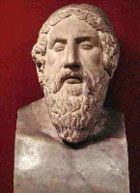

Homer Poems
Now when Dawn in robe of saffron was hasting from the streams of
Oceanus, to bring light to mortals and immortals, Thetis reached the
ships with the armour that the god had given her. She found her son
fallen about the body of Patroclus and weeping bitterly. Many also
...
And now as Dawn rose from her couch beside Tithonus, harbinger of
light alike to mortals and immortals, Jove sent fierce Discord with
the ensign of war in her hands to the ships of the Achaeans. She
took her stand by the huge black hull of Ulysses' ship which was
...
Now the other gods and the armed warriors on the plain slept
soundly, but Jove was wakeful, for he was thinking how to do honour to
Achilles, and destroyed much people at the ships of the Achaeans. In
the end he deemed it would be best to send a lying dream to King
...
Brave Menelaus son of Atreus now came to know that Patroclus had
fallen, and made his way through the front ranks clad in full armour
to bestride him. As a cow stands lowing over her first calf, even so
did yellow-haired Menelaus bestride Patroclus. He held his round
...
Thus the Trojans in the city, scared like fawns, wiped the sweat
from off them and drank to quench their thirst, leaning against the
goodly battlements, while the Achaeans with their shields laid upon
their shoulders drew close up to the walls. But stern fate bade Hector
...
Now the other princes of the Achaeans slept soundly the whole
night through, but Agamemnon son of Atreus was troubled, so that he
could get no rest. As when fair Juno's lord flashes his lightning in
token of great rain or hail or snow when the snow-flakes whiten the
...
So the son of Menoetius was attending to the hurt of Eurypylus
within the tent, but the Argives and Trojans still fought desperately,
nor were the trench and the high wall above it, to keep the Trojans in
check longer. They had built it to protect their ships, and had dug
...
With these words Hector passed through the gates, and his brother
Alexandrus with him, both eager for the fray. As when heaven sends a
breeze to sailors who have long looked for one in vain, and have
laboured at their oars till they are faint with toil, even so
...
Nestor was sitting over his wine, but the cry of battle did not
escape him, and he said to the son of Aesculapius, "What, noble
Machaon, is the meaning of all this? The shouts of men fighting by our
ships grow stronger and stronger; stay here, therefore, and sit over
...
Thus, then, did the Achaeans arm by their ships round you, O son
of Peleus, who were hungering for battle; while the Trojans over
against them armed upon the rise of the plain.
Meanwhile Jove from the top of many-delled Olympus, bade Themis
...
But when their flight had taken them past the trench and the set
stakes, and many had fallen by the hands of the Danaans, the Trojans
made a halt on reaching their chariots, routed and pale with fear.
Jove now woke on the crests of Ida, where he was lying with
...
Thus did they make their moan throughout the city, while the
Achaeans when they reached the Hellespont went back every man to his
own ship. But Achilles would not let the Myrmidons go, and spoke to
his brave comrades saying, "Myrmidons, famed horsemen and my own
...
When the companies were thus arrayed, each under its own captain,
the Trojans advanced as a flight of wild fowl or cranes that scream
overhead when rain and winter drive them over the flowing waters of
Oceanus to bring death and destruction on the Pygmies, and they
...
Now the gods were sitting with Jove in council upon the golden floor
while Hebe went round pouring out nectar for them to drink, and as
they pledged one another in their cups of gold they looked down upon
the town of Troy. The son of Saturn then began to tease Juno,
...
Thus did the Trojans watch. But Panic, comrade of blood-stained
Rout, had taken fast hold of the Achaeans and their princes were all
of them in despair. As when the two winds that blow from Thrace- the
north and the northwest- spring up of a sudden and rouse the fury of
...
Then Ulysses tore off his rags, and sprang on to the broad
pavement with his bow and his quiver full of arrows. He shed the
arrows on to the ground at his feet and said, "The mighty contest is
at an end. I will now see whether Apollo will vouchsafe it to me to
...
Then Pallas Minerva put valour into the heart of Diomed, son of
Tydeus, that he might excel all the other Argives, and cover himself
with glory. She made a stream of fire flare from his shield and helmet
like the star that shines most brilliantly in summer after its bath in
...
Now when Morning, clad in her robe of saffron, had begun to suffuse
light over the earth, Jove called the gods in council on the topmost
crest of serrated Olympus. Then he spoke and all the other gods gave
ear. "Hear me," said he, "gods and goddesses, that I may speak even as
...
Thence we went on to the Aeoli island where lives Aeolus son of
Hippotas, dear to the immortal gods. It is an island that floats (as
it were) upon the sea, iron bound with a wall that girds it. Now,
Aeolus has six daughters and six lusty sons, so he made the sons marry
...
And Ulysses answered, "King Alcinous, it is a good thing to hear a
bard with such a divine voice as this man has. There is nothing better
or more delightful than when a whole people make merry together,
with the guests sitting orderly to listen, while the table is loaded
...
Homer Biography
In the Western classical tradition, Homer is the author of the Iliad and the Odyssey, and is revered as the greatest ancient Greek epic poet. These epics lie at the beginning of the Western canon of literature, and have had an enormous influence on the history of literature. When he lived is controversial. Herodotus estimates that Homer lived 400 years before Herodotus' own time, which would place him at around 850 BC; while other ancient sources claim that he lived much nearer to the supposed time of the Trojan War, in the early 12th century BC The formative influence played by the Homeric epics in shaping Greek culture was widely recognized, and Homer was described as the teacher of Greece.Homer's works, which are about fifty percent speeches, provided models in persuasive speaking and writing that were emulated throughout the ancient and medieval Greek worlds. Fragments of Homer account for nearly half of all identifiable Greek literary papyrus finds. Period For modern scholars "the date of Homer" refers not to an individual, but to the period when the epics were created. The consensus is that "the Iliad and the Odyssey date from around the 8th century BC, the Iliad being composed before the Odyssey, perhaps by some decades," i.e. earlier than Hesiod the Iliad being the oldest work of Western literature. Over the past few decades, some scholars have argued for a 7th century BC date. Some of those who argue that the Homeric poems developed gradually over a long period of time give an even later date for the composition of the poems; according to Gregory Nagy for example, they only became fixed texts in the 6th century BC. The question of the historicity of Homer the individual is known as the "Homeric question"; there is no reliable biographical information handed down from classical antiquity. The poems are generally seen as the culmination of many generations of oral story-telling, in a tradition with a well-developed formulaic system of poetic composition. Some scholars, such as Martin West, claim that "Homer" is "not the name of a historical poet, but a fictitious or constructed name." Life and legends "Homer" is a Greek name, attested in Aeolic-speaking areas, and although nothing definite is known about him, traditions arose purporting to give details of his birthplace and background. The satirist Lucian, in his True History, describes him as a Babylonian called Tigranes, who assumed the name Homer when taken "hostage" (homeros) by the Greeks. When the Emperor Hadrian asked the Oracle at Delphi about Homer, the Pythia proclaimed that he was Ithacan, the son of Epikaste and Telemachus, from the Odyssey. These stories were incorporated into the various Lives of Homer compiled from the Alexandrian period onwards. Homer is most frequently said to be born in the Ionian region of Asia Minor, at Smyrna, or on the island of Chios, dying on the Cycladic island of Ios. A connection with Smyrna seems to be alluded to in a legend that his original name was Melesigenes ("born of Meles", a river which flowed by that city), with his mother the nymph Kretheis. Internal evidence from the poems gives evidence of familiarity with the topography and place-names of this area of Asia Minor, for example, Homer refers to meadow birds at the mouth of the Caystros , a storm in the Icarian sea (Iliad 2.144ff.), and mentions that women in Maeonia and Caria stain ivory with scarlet . The association with Chios dates back to at least Semonides of Amorgos, who cited a famous line in the Iliad (6.146) as by "the man of Chios". An eponymous bardic guild, known as the Homeridae (sons of Homer), or Homeristae ('Homerizers') appears to have existed there, tracing descent from an ancestor of that name, or upholding their function as rhapsodes or "lay-stitchers" specialising in the recitation of Homeric poetry. Wilhelm Dörpfeld suggests that Homer had visited many of the places and regions which he describes in his epics, such as Mycenae, Troy, the palace of Odysseus at Ithaca and more. According to Diodorus Siculus, Homer had even visited Egypt. The poet's name is homophonous with ὅμηρος (hómēros), "hostage" (or "surety"), which is interpreted as meaning "he who accompanies; he who is forced to follow", or, in some dialects, "blind". This led to many tales that he was a hostage or a blind man. Traditions which assert that he was blind may have arisen from the meaning of the word in both Ionic, where the verbal form ὁμηρεύω (homēreúō) has the specialized meaning of "guide the blind", and the Aeolian dialect of Cyme, where ὅμηρος (hómēros) is synonymous with the standard Greek τυφλός (tuphlós), meaning 'blind'. The characterization of Homer as a blind bard goes back to some verses in the Delian Hymn to Apollo, the third of the Homeric Hymns, verses later cited to support this notion by Thucydides.The Cymean historian Ephorus held the same view, and the idea gained support in antiquity on the strength of a false etymology which derived his name from ho mḕ horṓn (ὁ μὴ ὁρῶν: "he who does not see"). Critics have long taken as self-referential a passage in the Odyssey describing a blind bard, Demodocus, in the court of the Phaeacian king, who recounts stories of Troy to the shipwrecked Odysseus. Many scholars take the name of the poet to be indicative of a generic function. Gregory Nagy takes it to mean "he who fits (the Song) together". ὁμηρέω (homēréō), another related verb, besides signifying "meet", can mean "(sing) in accord/tune". Some argue that "Homer" may have meant "he who puts the voice in tune" with dancing. Marcello Durante links "Homeros" to an epithet of Zeus as "god of the assemblies" and argues that behind the name lies the echo of an archaic word for "reunion", similar to the later Panegyris, denoting a formal assembly of competing minstrels. Some Ancient Lives depict Homer as a wandering minstrel, like Thamyris or Hesiod, who walked as far as Chalkis to sing at the funeral games of Amphidamas. We are given the image of a "blind, begging singer who hangs around with little people: shoemakers, fisherman, potters, sailors, elderly men in the gathering places of harbour towns". The poems, on the other hand, give us evidence of singers at the courts of the nobility. There is a strong aristocratic bias in the poems demonstrated by the lack of any major protagonists of non-aristocratic stock, and by episodes such as the beating down of the commoner Thersites by the king Odysseus for daring to criticize his superiors. In spite of this scholars are divided as to which category, if any, the court singer or the wandering minstrel, the historic "Homer" belonged. Works attributed to Homer The Greeks of the sixth and early fifth centuries BC understood by "Homer", generally, "the whole body of heroic tradition as embodied in hexameter verse". Thus, in addition to the Iliad and the Odyssey, there are "exceptional" epics which organize their respective themes on a "massive scale". Many other works were credited to Homer in antiquity, including the entire Epic Cycle. The genre included further poems on the Trojan War, such as the Little Iliad, the Nostoi, the Cypria, and the Epigoni, as well as the Theban poems about Oedipus and his sons. Other works, such as the corpus of Homeric Hymns, the comic mini-epic Batrachomyomachia ("The Frog-Mouse War"), and the Margites were also attributed to him, but this is now believed to be unlikely. Two other poems, the Capture of Oechalia and the Phocais were also assigned Homeric authorship, but the question of the identities of the authors of these various texts is even more problematic than that of the authorship of the two major epics. Problems of authorship The idea that Homer was responsible for just the two outstanding epics, the Iliad and the Odyssey, did not win consensus until 350 BC. While many find it unlikely that both epics were composed by the same person, others argue that the stylistic similarities are too consistent to support the theory of multiple authorship. One view which attempts to bridge the differences holds that the Iliad was composed by "Homer" in his maturity, while the Odyssey was a work of his old age. The Batrachomyomachia, Homeric Hymns and cyclic epics are generally agreed to be later than the Iliad and the Odyssey. Most scholars agree that the Iliad and Odyssey underwent a process of standardisation and refinement out of older material beginning in the 8th century BC. An important role in this standardisation appears to have been played by the Athenian tyrant Hipparchus, who reformed the recitation of Homeric poetry at the Panathenaic festival. Many classicists hold that this reform must have involved the production of a canonical written text. Other scholars still support the idea that Homer was a real person. Since nothing is known about the life of this Homer, the common joke—also recycled with regard to Shakespeare—has it that the poems "were not written by Homer, but by another man of the same name." Samuel Butler argues, based on literary observations, that a young Sicilian woman wrote the Odyssey (but not the Iliad),an idea further pursued by Robert Graves in his novel Homer's Daughter and Andrew Dalby in Rediscovering Homer. Independent of the question of single authorship is the near-universal agreement, after the work of Milman Parry, that the Homeric poems are dependent on an oral tradition, a generations-old technique that was the collective inheritance of many singer-poets (aoidoi). An analysis of the structure and vocabulary of the Iliad and Odyssey shows that the poems contain many formulaic phrases typical of extempore epic traditions; even entire verses are at times repeated. Parry and his student Albert Lord pointed out that such elaborate oral tradition, foreign to today's literate cultures, is typical of epic poetry in a predominantly oral cultural milieu, the key words being "oral" and "traditional". Parry started with "traditional": the repetitive chunks of language, he said, were inherited by the singer-poet from his predecessors, and were useful to him in composition. Parry called these repetitive chunks "formulas". Exactly when these poems would have taken on a fixed written form is subject to debate. The traditional solution is the "transcription hypothesis", wherein a non-literate "Homer" dictates his poem to a literate scribe between the 8th and 6th centuries BC. The Greek alphabet was introduced in the early 8th century BC, so it is possible that Homer himself was of the first generation of authors who were also literate. The classicist Barry B. Powell suggests that the Greek alphabet was invented ca. 800 BC by one man, probably Homer, in order to write down oral epic poetry. More radical Homerists like Gregory Nagy contend that a canonical text of the Homeric poems as "scripture" did not exist until the Hellenistic period (3rd to 1st century BC). New methods try also to elucidate the question. Combining information technologies and statistics, the stylometry allows to scan various linguistic units: words, parts of speech, sounds... Based on the frequencies of Greek letters, a first study of Dietmar Najock particularly shows the internal cohesion of the Iliad and the Odysssey. Taking into account the repartition of the letters, a recent study of Stephan Vonfelt highlights the unity of the works of Homer compared to Hesiod. The thesis of modern Analysts being questioned, the debate remains open. Homeric studies The study of Homer is one of the oldest topics in scholarship, dating back to antiquity. The aims and achievements of Homeric studies have changed over the course of the millennia. In the last few centuries, they have revolved around the process by which the Homeric poems came into existence and were transmitted over time to us, first orally and later in writing. Some of the main trends in modern Homeric scholarship have been, in the 19th and early 20th centuries, Analysis and Unitarianism (see Homeric Question), schools of thought which emphasized on the one hand the inconsistencies in, and on the other the artistic unity of, Homer; and in the 20th century and later Oral Theory, the study of the mechanisms and effects of oral transmission, and Neoanalysis, the study of the relationship between Homer and other early epic material. Homeric dialect The language used by Homer is an archaic version of Ionic Greek, with admixtures from certain other dialects, such as Aeolic Greek. It later served as the basis of Epic Greek, the language of epic poetry, typically in dactylic hexameter. Homeric style Aristotle remarks in his Poetics that Homer was unique among the poets of his time, focusing on a single unified theme or action in the epic cycle. The cardinal qualities of the style of Homer are well articulated by Matthew Arnold: [T]he translator of Homer should above all be penetrated by a sense of four qualities of his author:—that he is eminently rapid; that he is eminently plain and direct, both in the evolution of his thought and in the expression of it, that is, both in his syntax and in his words; that he is eminently plain and direct in the substance of his thought, that is, in his matter and ideas; and finally, that he is eminently noble. The peculiar rapidity of Homer is due in great measure to his use of hexameter verse. It is characteristic of early literature that the evolution of the thought, or the grammatical form of the sentence, is guided by the structure of the verse; and the correspondence which consequently obtains between the rhythm and the syntax—the thought being given out in lengths, as it were, and these again divided by tolerably uniform pauses—produces a swift flowing movement such as is rarely found when periods are constructed without direct reference to the metre. That Homer possesses this rapidity without falling into the corresponding faults, that is, without becoming either fluctuant or monotonous, is perhaps the best proof of his unequalled poetic skill. The plainness and directness of both thought and expression which characterise him were doubtless qualities of his age, but the author of the Iliad (similar to Voltaire, to whom Arnold happily compares him) must have possessed this gift in a surpassing degree. The Odyssey is in this respect perceptibly below the level of the Iliad. Rapidity or ease of movement, plainness of expression, and plainness of thought are not distinguishing qualities of the great epic poets Virgil, Dante, and Milton. On the contrary, they belong rather to the humbler epico-lyrical school for which Homer has been so often claimed. The proof that Homer does not belong to that school—and that his poetry is not in any true sense ballad poetry—is furnished by the higher artistic structure of his poems and, as regards style, by the fourth of the qualities distinguished by Arnold: the quality of nobleness. It is his noble and powerful style, sustained through every change of idea and subject, that finally separates Homer from all forms of ballad poetry and popular epic. Like the French epics, such as the Chanson de Roland, Homeric poetry is indigenous and, by the ease of movement and its resultant simplicity, distinguishable from the works of Dante, Milton and Virgil. It is also distinguished from the works of these artists by the comparative absence of underlying motives or sentiment. In Virgil's poetry, a sense of the greatness of Rome and Italy is the leading motive of a passionate rhetoric, partly veiled by the considered delicacy of his language. Dante and Milton are still more faithful exponents of the religion and politics of their time. Even the French epics display sentiments of fear and hatred of the Saracens; but, in Homer's works, the interest is purely dramatic. There is no strong antipathy of race or religion; the war turns on no political events; the capture of Troy lies outside the range of the Iliad; and even the protagonists are not comparable to the chief national heroes of Greece. So far as can be seen, the chief interest in Homer's works is that of human feeling and emotion, and of drama; indeed, his works are often referred to as "dramas". Greece according to the Iliad The excavations of Heinrich Schliemann at Hisarlik in the late 19th century provided initial evidence to scholars that there was an historical basis for the Trojan War. Research into oral epics in Serbo-Croatian and Turkic languages, pioneered by the aforementioned Parry and Lord, began convincing scholars that long poems could be preserved with consistency by oral cultures until they are written down. The decipherment of Linear B in the 1950s by Michael Ventris (and others) convinced many of a linguistic continuity between 13th century BC Mycenaean writings and the poems attributed to Homer. It is probable, therefore, that the story of the Trojan War as reflected in the Homeric poems derives from a tradition of epic poetry founded on a war which actually took place. It is crucial, however, not to underestimate the creative and transforming power of subsequent tradition: for instance, Achilles, the most important character of the Iliad, is strongly associated with southern Thessaly, but his legendary figure is interwoven into a tale of war whose kings were from the Peloponnese. Tribal wanderings were frequent, and far-flung, ranging over much of Greece and the Eastern Mediterranean. The epic weaves brilliantly the disiecta membra (scattered remains) of these distinct tribal narratives, exchanged among clan bards, into a monumental tale in which Greeks join collectively to do battle on the distant plains of Troy. Hero cult The Apotheosis of Homer, by Archelaus of Priene (marble relief, possibly 3rd century BC, now in the British Museum) In the Hellenistic period, Homer was the subject of a hero cult in several cities. A shrine, the Homereion, was devoted to him in Alexandria by Ptolemy IV Philopator in the late 3rd century BC. This shrine is described in Aelian's 3rd century AD work Varia Historia. He tells how Ptolemy "placed in a circle around the statue [of Homer] all the cities who laid claim to Homer" and mentions a painting of the poet by the artist Galaton, which apparently depicted Homer in the aspect of Oceanus as the source of all poetry. A marble relief, found in Italy but thought to have been sculpted in Egypt, depicts the apotheosis of Homer. It shows Ptolemy and his wife or sister Arsinoe III standing beside a seated poet, flanked by figures from the Odyssey and Iliad, with the nine Muses standing above them and a procession of worshippers approaching an altar, believed to represent the Alexandrine Homereion. Apollo, the god of music and poetry, also appears, along with a female figure tentatively identified as Mnemosyne, the mother of the Muses. Zeus, the king of the gods, presides over the proceedings. The relief demonstrates vividly that the Greeks considered Homer not merely a great poet but the divinely inspired reservoir of all literature. Homereia also stood at Chios, Ephesus, and Smyrna, which were among the city-states that claimed to be his birthplace. Strabo (14.1.37) records an Homeric temple in Smyrna with an ancient xoanon or cult statue of the poet. He also mentions sacrifices carried out to Homer by the inhabitants of Argos, presumably at another Homereion. Transmission and publication Though evincing many features characteristic of oral poetry, the Iliad and Odyssey were at some point committed to writing. The Greek script, adapted from a Phoenician syllabary around 800 BC, made possible the notation of the complex rhythms and vowel clusters that make up hexameter verse. Homer's poems appear to have been recorded shortly after the alphabet's invention: an inscription from Ischia in the Bay of Naples, ca. 740 BC, appears to refer to a text of the Iliad; likewise, illustrations seemingly inspired by the Polyphemus episode in the Odyssey are found on Samos, Mykonos and in Italy, dating from the first quarter of the seventh century BC. We have little information about the early condition of the Homeric poems, but in the second century BC, Alexandrian editors stabilized this text from which all modern texts descend. In late antiquity, knowledge of Greek declined in Latin-speaking western Europe and, along with it, knowledge of Homer's poems. It was not until the fifteenth century AD that Homer's work began to be read once more in Italy. By contrast it was continually read and taught in the Greek-speaking Eastern Roman Empire where the majority of the classics also survived. The first printed edition appeared in 1488 (edited by Demetrios Chalkokondyles and published by Bernardus Nerlius, Nerius Nerlius, and Demetrius Damilas in Florence, Italy).)
The Best Poem Of Homer
The Iliad: Book 19
Now when Dawn in robe of saffron was hasting from the streams of
Oceanus, to bring light to mortals and immortals, Thetis reached the
ships with the armour that the god had given her. She found her son
fallen about the body of Patroclus and weeping bitterly. Many also
of his followers were weeping round him, but when the goddess came
among them she clasped his hand in her own, saying, "My son, grieve as
we may we must let this man lie, for it is by heaven's will that he
has fallen; now, therefore, accept from Vulcan this rich and goodly
armour, which no man has ever yet borne upon his shoulders."
As she spoke she set the armour before Achilles, and it rang out
bravely as she did so. The Myrmidons were struck with awe, and none
dared look full at it, for they were afraid; but Achilles was roused
to still greater fury, and his eyes gleamed with a fierce light, for
he was glad when he handled the splendid present which the god had
made him. Then, as soon as he had satisfied himself with looking at
it, he said to his mother, "Mother, the god has given me armour,
meet handiwork for an immortal and such as no living could have
fashioned; I will now arm, but I much fear that flies will settle upon
the son of Menoetius and breed worms about his wounds, so that his
body, now he is dead, will be disfigured and the flesh will rot."
Silver-footed Thetis answered, "My son, be not disquieted about this
matter. I will find means to protect him from the swarms of noisome
flies that prey on the bodies of men who have been killed in battle.
He may lie for a whole year, and his flesh shall still be as sound
as ever, or even sounder. Call, therefore, the Achaean heroes in
assembly; unsay your anger against Agamemnon; arm at once, and fight
with might and main."
As she spoke she put strength and courage into his heart, and she
then dropped ambrosia and red nectar into the wounds of Patroclus,
that his body might suffer no change.
Then Achilles went out upon the seashore, and with a loud cry called
on the Achaean heroes. On this even those who as yet had stayed always
at the ships, the pilots and helmsmen, and even the stewards who
were about the ships and served out rations, all came to the place
of assembly because Achilles had shown himself after having held aloof
so long from fighting. Two sons of Mars, Ulysses and the son of
Tydeus, came limping, for their wounds still pained them; nevertheless
they came, and took their seats in the front row of the assembly. Last
of all came Agamemnon, king of men, he too wounded, for Coon son of
Antenor had struck him with a spear in battle.
When the Achaeans were got together Achilles rose and said, "Son
of Atreus, surely it would have been better alike for both you and me,
when we two were in such high anger about Briseis, surely it would
have been better, had Diana's arrow slain her at the ships on the
day when I took her after having sacked Lyrnessus. For so, many an
Achaean the less would have bitten dust before the foe in the days
of my anger. It has been well for Hector and the Trojans, but the
Achaeans will long indeed remember our quarrel. Now, however, let it
be, for it is over. If we have been angry, necessity has schooled
our anger. I put it from me: I dare not nurse it for ever;
therefore, bid the Achaeans arm forthwith that I may go out against
the Trojans, and learn whether they will be in a mind to sleep by
the ships or no. Glad, I ween, will he be to rest his knees who may
fly my spear when I wield it."
Thus did he speak, and the Achaeans rejoiced in that he had put away
his anger.
Then Agamemnon spoke, rising in his place, and not going into the
middle of the assembly. "Danaan heroes," said he, "servants of Mars,
it is well to listen when a man stands up to speak, and it is not
seemly to interrupt him, or it will go hard even with a practised
speaker. Who can either hear or speak in an uproar? Even the finest
orator will be disconcerted by it. I will expound to the son of
Peleus, and do you other Achaeans heed me and mark me well. Often have
the Achaeans spoken to me of this matter and upbraided me, but it
was not I that did it: Jove, and Fate, and Erinys that walks in
darkness struck me mad when we were assembled on the day that I took
from Achilles the meed that had been awarded to him. What could I
do? All things are in the hand of heaven, and Folly, eldest of
Jove's daughters, shuts men's eyes to their destruction. She walks
delicately, not on the solid earth, but hovers over the heads of men
to make them stumble or to ensnare them.
"Time was when she fooled Jove himself, who they say is greatest
whether of gods or men; for Juno, woman though she was, beguiled him
on the day when Alcmena was to bring forth mighty Hercules in the fair
city of Thebes. He told it out among the gods saying, 'Hear me all
gods and goddesses, that I may speak even as I am minded; this day
shall an Ilithuia, helper of women who are in labour, bring a man
child into the world who shall be lord over all that dwell about him
who are of my blood and lineage.' Then said Juno all crafty and full
of guile, 'You will play false, and will not hold to your word.
Swear me, O Olympian, swear me a great oath, that he who shall this
day fall between the feet of a woman, shall be lord over all that
dwell about him who are of your blood and lineage.'
"Thus she spoke, and Jove suspected her not, but swore the great
oath, to his much ruing thereafter. For Juno darted down from the high
summit of Olympus, and went in haste to Achaean Argos where she knew
that the noble wife of Sthenelus son of Perseus then was. She being
with child and in her seventh month, Juno brought the child to birth
though there was a month still wanting, but she stayed the offspring
of Alcmena, and kept back the Ilithuiae. Then she went to tell Jove
the son of Saturn, and said, 'Father Jove, lord of the lightning- I
have a word for your ear. There is a fine child born this day,
Eurystheus, son to Sthenelus the son of Perseus; he is of your
lineage; it is well, therefore, that he should reign over the
Argives.'
"On this Jove was stung to the very quick, and in his rage he caught
Folly by the hair, and swore a great oath that never should she
again invade starry heaven and Olympus, for she was the bane of all.
Then he whirled her round with a twist of his hand, and flung her down
from heaven so that she fell on to the fields of mortal men; and he
was ever angry with her when he saw his son groaning under the cruel
labours that Eurystheus laid upon him. Even so did I grieve when
mighty Hector was killing the Argives at their ships, and all the time
I kept thinking of Folly who had so baned me. I was blind, and Jove
robbed me of my reason; I will now make atonement, and will add much
treasure by way of amends. Go, therefore, into battle, you and your
people with you. I will give you all that Ulysses offered you
yesterday in your tents: or if it so please you, wait, though you
would fain fight at once, and my squires shall bring the gifts from my
ship, that you may see whether what I give you is enough."
And Achilles answered, "Son of Atreus, king of men Agamemnon, you
can give such gifts as you think proper, or you can withhold them:
it is in your own hands. Let us now set battle in array; it is not
well to tarry talking about trifles, for there is a deed which is as
yet to do. Achilles shall again be seen fighting among the foremost,
and laying low the ranks of the Trojans: bear this in mind each one of
you when he is fighting."
Then Ulysses said, "Achilles, godlike and brave, send not the
Achaeans thus against Ilius to fight the Trojans fasting, for the
battle will be no brief one, when it is once begun, and heaven has
filled both sides with fury; bid them first take food both bread and
wine by the ships, for in this there is strength and stay. No man
can do battle the livelong day to the going down of the sun if he is
without food; however much he may want to fight his strength will fail
him before he knows it; hunger and thirst will find him out, and his
limbs will grow weary under him. But a man can fight all day if he
is full fed with meat and wine; his heart beats high, and his strength
will stay till he has routed all his foes; therefore, send the
people away and bid them prepare their meal; King Agamemnon will bring
out the gifts in presence of the assembly, that all may see them and
you may be satisfied. Moreover let him swear an oath before the
Argives that he has never gone up into the couch of Briseis, nor
been with her after the manner of men and women; and do you, too, show
yourself of a gracious mind; let Agamemnon entertain you in his
tents with a feast of reconciliation, that so you may have had your
dues in full. As for you, son of Atreus, treat people more righteously
in future; it is no disgrace even to a king that he should make amends
if he was wrong in the first instance."
And King Agamemnon answered, "Son of Laertes, your words please me
well, for throughout you have spoken wisely. I will swear as you would
have me do; I do so of my own free will, neither shall I take the name
of heaven in vain. Let, then, Achilles wait, though he would fain
fight at once, and do you others wait also, till the gifts come from
my tent and we ratify the oath with sacrifice. Thus, then, do I charge
you: take some noble young Achaeans with you, and bring from my
tents the gifts that I promised yesterday to Achilles, and bring the
women also; furthermore let Talthybius find me a boar from those
that are with the host, and make it ready for sacrifice to Jove and to
the sun."
Then said Achilles, "Son of Atreus, king of men Agamemnon, see to
these matters at some other season, when there is breathing time and
when I am calmer. Would you have men eat while the bodies of those
whom Hector son of Priam slew are still lying mangled upon the
plain? Let the sons of the Achaeans, say I, fight fasting and
without food, till we have avenged them; afterwards at the going
down of the sun let them eat their fill. As for me, Patroclus is lying
dead in my tent, all hacked and hewn, with his feet to the door, and
his comrades are mourning round him. Therefore I can take thought of
nothing save only slaughter and blood and the rattle in the throat
of the dying."
Ulysses answered, "Achilles, son of Peleus, mightiest of all the
Achaeans, in battle you are better than I, and that more than a
little, but in counsel I am much before you, for I am older and of
greater knowledge. Therefore be patient under my words. Fighting is
a thing of which men soon surfeit, and when Jove, who is wars steward,
weighs the upshot, it may well prove that the straw which our
sickles have reaped is far heavier than the grain. It may not be
that the Achaeans should mourn the dead with their bellies; day by day
men fall thick and threefold continually; when should we have
respite from our sorrow? Let us mourn our dead for a day and bury them
out of sight and mind, but let those of us who are left eat and
drink that we may arm and fight our foes more fiercely. In that hour
let no man hold back, waiting for a second summons; such summons shall
bode ill for him who is found lagging behind at our ships; let us
rather sally as one man and loose the fury of war upon the Trojans."
When he had thus spoken he took with him the sons of Nestor, with
Meges son of Phyleus, Thoas, Meriones, Lycomedes son of Creontes,
and Melanippus, and went to the tent of Agamemnon son of Atreus. The
word was not sooner said than the deed was done: they brought out
the seven tripods which Agamemnon had promised, with the twenty
metal cauldrons and the twelve horses; they also brought the women
skilled in useful arts, seven in number, with Briseis, which made
eight. Ulysses weighed out the ten talents of gold and then led the
way back, while the young Achaeans brought the rest of the gifts,
and laid them in the middle of the assembly.
Agamemnon then rose, and Talthybius whose voice was like that of a
god came to him with the boar. The son of Atreus drew the knife
which he wore by the scabbard of his mighty sword, and began by
cutting off some bristles from the boar, lifting up his hands in
prayer as he did so. The other Achaeans sat where they were all silent
and orderly to hear the king, and Agamemnon looked into the vault of
heaven and prayed saying, "I call Jove the first and mightiest of
all gods to witness, I call also Earth and Sun and the Erinyes who
dwell below and take vengeance on him who shall swear falsely, that
I have laid no hand upon the girl Briseis, neither to take her to my
bed nor otherwise, but that she has remained in my tents inviolate. If
I swear falsely may heaven visit me with all the penalties which it
metes out to those who perjure themselves."
He cut the boar's throat as he spoke, whereon Talthybius whirled
it round his head, and flung it into the wide sea to feed the
fishes. Then Achilles also rose and said to the Argives, "Father Jove,
of a truth you blind men's eyes and bane them. The son of Atreus had
not else stirred me to so fierce an anger, nor so stubbornly taken
Briseis from me against my will. Surely Jove must have counselled
the destruction of many an Argive. Go, now, and take your food that we
may begin fighting."
On this he broke up the assembly, and every man went back to his own
ship. The Myrmidons attended to the presents and took them away to the
ship of Achilles. They placed them in his tents, while the
stable-men drove the horses in among the others.
Briseis, fair as Venus, when she saw the mangled body of
Patroclus, flung herself upon it and cried aloud, tearing her
breast, her neck, and her lovely face with both her hands. Beautiful
as a goddess she wept and said, "Patroclus, dearest friend, when I
went hence I left you living; I return, O prince, to find you dead;
thus do fresh sorrows multiply upon me one after the other. I saw
him to whom my father and mother married me, cut down before our city,
and my three own dear brothers perished with him on the self-same day;
but you, Patroclus, even when Achilles slew my husband and sacked
the city of noble Mynes, told me that I was not to weep, for you
said you would make Achilles marry me, and take me back with him to
Phthia, we should have a wedding feast among the Myrmidons. You were
always kind to me and I shall never cease to grieve for you."
She wept as she spoke, and the women joined in her lament-making
as though their tears were for Patroclus, but in truth each was
weeping for her own sorrows. The elders of the Achaeans gathered round
Achilles and prayed him to take food, but he groaned and would not
do so. "I pray you," said he, "if any comrade will hear me, bid me
neither eat nor drink, for I am in great heaviness, and will stay
fasting even to the going down of the sun."
On this he sent the other princes away, save only the two sons of
Atreus and Ulysses, Nestor, Idomeneus, and the knight Phoenix, who
stayed behind and tried to comfort him in the bitterness of his
sorrow: but he would not be comforted till he should have flung
himself into the jaws of battle, and he fetched sigh on sigh, thinking
ever of Patroclus. Then he said-
"Hapless and dearest comrade, you it was who would get a good dinner
ready for me at once and without delay when the Achaeans were
hasting to fight the Trojans; now, therefore, though I have meat and
drink in my tents, yet will I fast for sorrow. Grief greater than this
I could not know, not even though I were to hear of the death of my
father, who is now in Phthia weeping for the loss of me his son, who
am here fighting the Trojans in a strange land for the accursed sake
of Helen, nor yet though I should hear that my son is no more- he
who is being brought up in Scyros- if indeed Neoptolemus is still
living. Till now I made sure that I alone was to fall here at Troy
away from Argos, while you were to return to Phthia, bring back my son
with you in your own ship, and show him all my property, my
bondsmen, and the greatness of my house- for Peleus must surely be
either dead, or what little life remains to him is oppressed alike
with the infirmities of age and ever present fear lest he should
hear the sad tidings of my death."
He wept as he spoke, and the elders sighed in concert as each
thought on what he had left at home behind him. The son of Saturn
looked down with pity upon them, and said presently to Minerva, "My
child, you have quite deserted your hero; is he then gone so clean out
of your recollection? There he sits by the ships all desolate for
the loss of his dear comrade, and though the others are gone to
their dinner he will neither eat nor drink. Go then and drop nectar
and ambrosia into his breast, that he may know no hunger."
With these words he urged Minerva, who was already of the same mind.
She darted down from heaven into the air like some falcon sailing on
his broad wings and screaming. Meanwhile the Achaeans were arming
throughout the host, and when Minerva had dropped nectar and
ambrosia into Achilles so that no cruel hunger should cause his
limbs to fail him, she went back to the house of her mighty father.
Thick as the chill snow-flakes shed from the hand of Jove and borne on
the keen blasts of the north wind, even so thick did the gleaming
helmets, the bossed shields, the strongly plated breastplates, and the
ashen spears stream from the ships. The sheen pierced the sky, the
whole land was radiant with their flashing armour, and the sound of
the tramp of their treading rose from under their feet. In the midst
of them all Achilles put on his armour; he gnashed his teeth, his eyes
gleamed like fire, for his grief was greater than he could bear. Thus,
then, full of fury against the Trojans, did he don the gift of the
god, the armour that Vulcan had made him.
First he put on the goodly greaves fitted with ancle-clasps, and
next he did on the breastplate about his chest. He slung the
silver-studded sword of bronze about his shoulders, and then took up
the shield so great and strong that shone afar with a splendour as
of the moon. As the light seen by sailors from out at sea, when men
have lit a fire in their homestead high up among the mountains, but
the sailors are carried out to sea by wind and storm far from the
haven where they would be- even so did the gleam of Achilles' wondrous
shield strike up into the heavens. He lifted the redoubtable helmet,
and set it upon his head, from whence it shone like a star, and the
golden plumes which Vulcan had set thick about the ridge of the
helmet, waved all around it. Then Achilles made trial of himself in
his armour to see whether it fitted him, so that his limbs could
play freely under it, and it seemed to buoy him up as though it had
been wings.
He also drew his father's spear out of the spear-stand, a spear so
great and heavy and strong that none of the Achaeans save only
Achilles had strength to wield it; this was the spear of Pelian ash
from the topmost ridges of Mt. Pelion, which Chiron had once given
to Peleus, fraught with the death of heroes. Automedon and Alcimus
busied themselves with the harnessing of his horses; they made the
bands fast about them, and put the bit in their mouths, drawing the
reins back towards the chariot. Automedon, whip in hand, sprang up
behind the horses, and after him Achilles mounted in full armour,
resplendent as the sun-god Hyperion. Then with a loud voice he
chided with his father's horses saying, "Xanthus and Balius, famed
offspring of Podarge- this time when we have done fighting be sure and
bring your driver safely back to the host of the Achaeans, and do
not leave him dead on the plain as you did Patroclus."
Then fleet Xanthus answered under the yoke- for white-armed Juno had
endowed him with human speech- and he bowed his head till his mane
touched the ground as it hung down from under the yoke-band. "Dread
Achilles," said he, "we will indeed save you now, but the day of
your death is near, and the blame will not be ours, for it will be
heaven and stern fate that will destroy you. Neither was it through
any sloth or slackness on our part that the Trojans stripped Patroclus
of his armour; it was the mighty god whom lovely Leto bore that slew
him as he fought among the foremost, and vouchsafed a triumph to
Hector. We two can fly as swiftly as Zephyrus who they say is fleetest
of all winds; nevertheless it is your doom to fall by the hand of a
man and of a god."
When he had thus said the Erinyes stayed his speech, and Achilles
answered him in great sadness, saying, "Why, O Xanthus, do you thus
foretell my death? You need not do so, for I well know that I am to
fall here, far from my dear father and mother; none the more, however,
shall I stay my hand till I have given the Trojans their fill of
fighting."
So saying, with a loud cry he drove his horses to the front.
Translated by Samuel Butler
Homer Comments
Please amend your otherwisw excellent website by giving Homer's approximate date to c 1100 BC. The initials BCE are unnecessarily offensive
O the great epic-poet, I have also a desire to write an epic-poem in Bangla, my mother language, on our great leader Bangabandhu.
Aristotle remarks in his Poetics that Homer was unique among the poets of his time, and indeed, the presumed author of the Iliad and the Odyssey must assuredly be one of the greatest of the world’s literary artists. He is also one of the most influential authors in the widest sense, for the two epics provided the basis of Greek education and culture throughout the Classical age and formed the backbone of humane education down to the time of the Roman Empire and the spread of Christianity...
The incomparable at his throne; Homer the legend. He is as alive as his works of literature; to me his envy, i want to die and live like he did.
oof oof oof oof oof oof oof oof oof oof oof oof oof oof oof oof oof oof oof oof oof oof
Homer Quotes
The generation of mankind is like the generation of leaves. The wind scatters the leaves on the ground, but the living tree burgeons with leaves again in the spring.
Hunger is insolent, and will be fed.


Delivering Poems Around The World
Poems are the property of their respective owners. All information has been reproduced here for educational and informational purposes to benefit site visitors, and is provided at no charge...
3/26/2026 10:16:04 AM # 1.0.0



I was inspired by the great poetic insperation of Homer..........His great epics impacted to change the entire western culture..............i love homer.......!